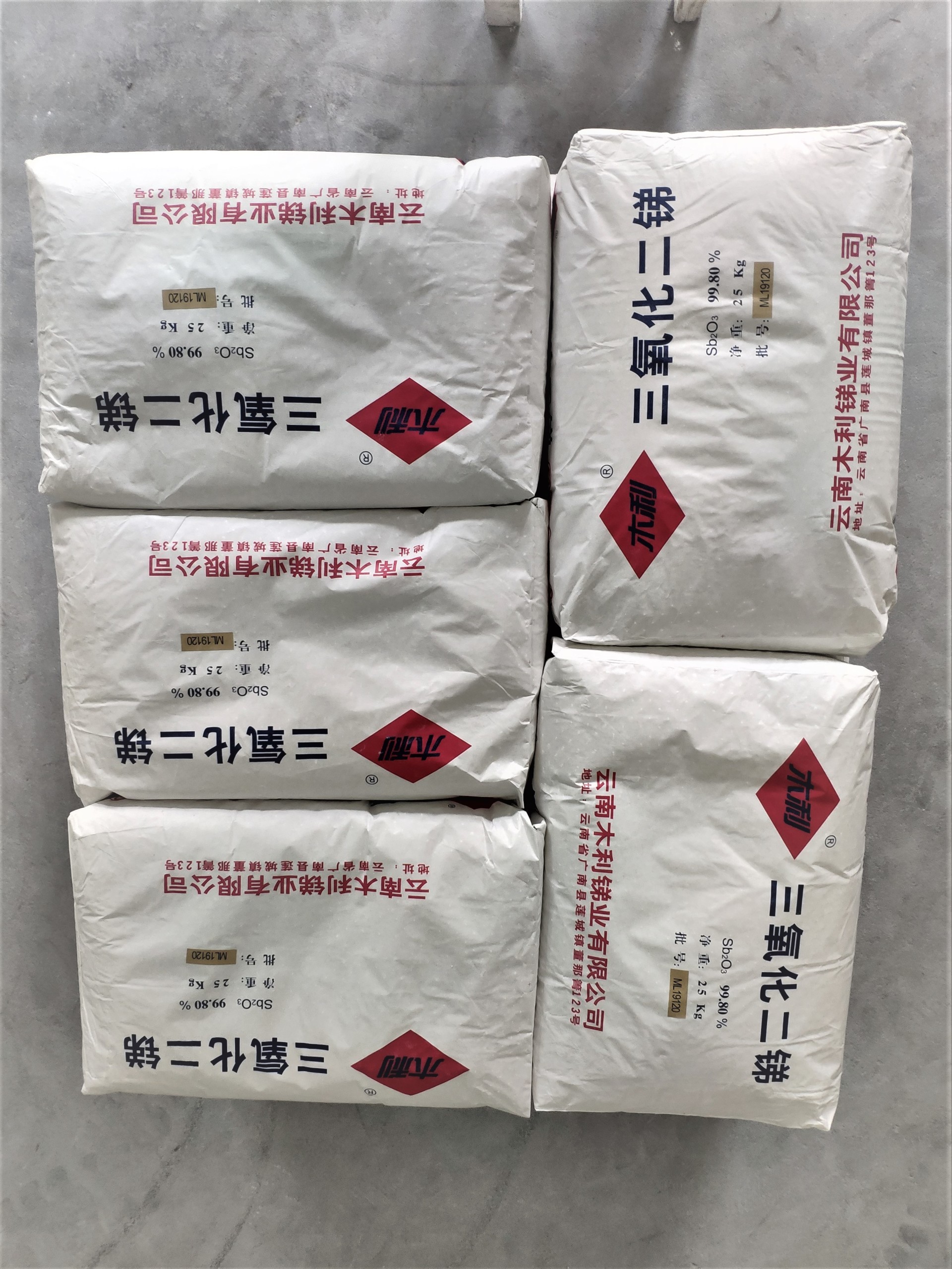
Antimony trioxide

Packaging: The product is packaged in double-layer bags—outer bags made of paper-plastic composites, and inner bags crafted from polyethylene film. Each bag has a net weight of 25.0 kg and is palletized into one-ton pallets. Alternatively, high-strength ton bags can also be used for one-ton-per-pallet packaging, with options available to meet specific customer requirements.

Keywords:

Antimony trioxide

packaging

antimony

polyethylene

weight

Product inquiries:

Product Description


Specifications:

Card Number

Sb 2 O 399.90

Sb 2 O 399.80

Sb 2 O 399.60

Chemical composition

Sb 2 O 3 %≥

99.90

99.80

99.60

As 2 O 3 %≤

0.030

0.05

0.06

PbO% ≤

0.040

0.08

0.10

Fe 2 O 3 % <

0.002

0.005

0.006

CuO% <

0.002

0.003

0.005

Se%<

0.002

0.003

0.005

Physical Properties

Average particle size (µm)

0.4–0.6

0.4–0.6

0.4–0.6

0.6–0.9

0.6–0.9

0.6–0.9

> 0.9

> 0.9

> 0.9

Whiteness % ≥

98.00

98.00

97.00

Note: Production can be organized according to specific requirements if requested by the buyer.

Property:

  Antimony trioxide (English name: Antimony trioxide) is a pure white, ultrafine powder with a cubic crystal structure, and it is the most stable compound of antimony. Its molecular weight is 291.5, melting point is 656°C, and its density in the stable cubic form is 5.3 g/cm³. Also known as antimony white, antimony trioxide is an amphoteric oxide—it is insoluble in water, ethanol, dilute sulfuric acid, and dilute nitric acid—but it readily dissolves in concentrated hydrochloric acid, sulfuric acid, strong alkalis, and tartaric acid solutions.


Usage:

  ⑴ Antimony trioxide is widely used as a synergistic flame retardant in plastic products such as polyvinyl chloride, polyethylene, polypropylene, polystyrene, ABS resin, polyester, polyurethane foam, epoxy resin, and phenolic resin, as well as in synthetic fibers like polypropylene and polyester. When added in specific proportions to flammable polymer materials alongside halogen-based flame retardants, antimony trioxide significantly boosts the material’s oxygen index (OI), enhancing its flame-retardant performance while maintaining excellent cost-effectiveness. It is thus regarded as the most important inorganic synergist for improving the flame-retardant properties of polymers.

  ⑵ Used as a rubber filler, a passivating agent in the petrochemical industry, a clarifying agent in glass manufacturing, a coloring agent in ceramics and enamel industries, for fabricating optoelectronic components, as a solid lubricant material, in antifouling coatings for ships, and in pharmaceutical applications, among other uses.


Manufacturing plant:

  Yunnan Muli Antimony Industry Co., Ltd.


Packaging:

  The product is packaged in a double-layer bag: the outer layer is a paper-plastic composite bag, while the inner layer is a polyethylene film bag. Each bag has a net weight of 25.0 kg and is palletized to form one-ton-per-pallet units. Additionally, high-strength ton bags are also available for one-ton-per-pallet packaging. Custom packaging options are also available upon request.


Storage:

  Store in a dry, clean place.


Related Products

Antimony glycol


Properties: Muli Brand Ethylene Glycol Antimony is primarily made from our high-purity antimony oxide as the main raw material

Antimony trioxide


Packaging: The product is packaged in double-layer bags—outer bags made of paper-plastic composites, and inner bags crafted from polyethylene film. Each bag has a net weight of 25.0 kg and is palletized into one-ton pallets. Alternatively, high-strength ton bags can also be used for one-ton-per-pallet packaging, with options available to meet specific customer requirements.

Antimony ingot


Specifications: Grade No.: Sb99.90, Sb99.85, Sb99.65 Size: 0-3mm Crushed Antimony, 3-8mm Crushed Antimony Composition: Sb% ≥99.90, 99.85, 99.65 As% ≤0.02, 0.05, 0.10 Fe% ≤0.015, 0.02, 0.03 S% ≤0.008, 0.04, 0.06 Cu% ≤0.01, 0.015, 0.05 Se% ≤0.003, 0.005, 0.005 Pb% ≤0.03, 0.08, 0.10 Bi% ≤0.0030, 0.005, 0.005 Total Impurities ≤0.10, 0.15, 0.35 Properties: Antimony is a non-ferrous heavy metal with a silvery-white appearance. It crystallizes in the hexagonal system, has a melting point of 630.5°C, a Mohs hardness of 3, and a density of 6.69 g/cm³. It is a poor conductor of heat and electricity. Antimony is brittle, easily ground into fine powder, but lacks ductility. At room temperature, it does not react with air or oxygen. Additionally, antimony is insoluble in water and generally resists reactions with acids. Applications: ⑴ Antimony is primarily used to enhance the properties of metals and alloys. It finds applications in: - Battery grids, lead plates, and connecting components; - Bearing alloys (such as bearing shells); - Antimony bronze; - Type metal for printing; - Cable armor (sheathing); - Lead sheets, pipes, and foils; - Soldering materials; - Soft tubing made from lead-based alloys via extrusion technology; - Ammunition bullets; - Soldering alloys (particularly for high-quality artistic castings and precision casting); - Hard lead products, among others. ⑵ Antimony compounds—such as antimony trioxide, antimony trisulfide, and various halogenated antimony compounds—are widely utilized across multiple industries, including plastics, synthetic fibers, enamelware, glass manufacturing, paint pigments, ammunition primers, matches, military applications, rubber production, and pharmaceuticals. Manufacturing Facility: Yunnan Muli Antimony Industry Co., Ltd. Packaging: Antimony ingots are packaged in wooden crates, with each crate weighing either 100 kg or 1000 kg net. Custom packaging options are also available upon request. Storage: Store in a dry, clean environment.

Crushed antimony


Specifications: 0–3 mm crushed antimony and 3–8 mm crushed antimony, produced using antimony ingots with an Sb content of 99.65% or higher, tailored to customer requirements. Properties: Antimony is a non-ferrous heavy metal. It has a silvery-white appearance and crystallizes in the hexagonal system. Its melting point is 630.5°C, with a Mohs hardness of 3 and a density of 6.69 g/cm³. Antimony is a poor conductor of heat and electricity. It is brittle, easily ground into fine particles, but lacks ductility. At room temperature, it does not react with air or oxygen. Additionally, antimony is insoluble in water and generally resists reactions with most acids. Applications: ⑴ Antimony is primarily used to enhance the properties of metals and alloys. Key applications include: - Battery grid plates, lead sheets, and connecting components; - Bearing alloys (such as bearing bushings); - Antimony bronze; - Type metal for printing; - Cable armor (sheathing); - Lead sheets, lead pipes, and lead foils; - Soldering materials; - Soft tubing made from lead-based alloys via extrusion technology; - Ammunition bullets; - Solder alloys (ideal for high-quality artistic castings and precision casting processes); - Hard lead products, among others. ⑵ Antimony is also essential in the production of antimony trioxide, antimony trisulfide, and various antimony halides—compounds widely utilized across industries such as plastics, synthetic fibers, enamelware, glass manufacturing, paint pigments, propellant primers for firearms and artillery shells, matches, military applications, rubber processing, and pharmaceuticals. Manufacturer: Yunnan Muli Antimony Industry Co., Ltd. Packaging: Crushed antimony (antimony granules) is packaged in galvanized iron drums, each with a net weight of 90 kg; customized packaging options are available upon request. Storage: Store in a dry, clean environment.

Welcome to leave us your message or inquiry.

Our staff will contact you within 24 hours (on business days). If you require additional services, please feel free to call our service hotline:13908861361